


Imagine a place on the Internet where discussing big ideas isn’t just about shouting opinions or proclaiming yourself the winner. It must be a rigorous process that demands each perspective gets scrutinized. It’s a place where we funnel our ideas towards the best solution that satisfies more people, solves more problems, and brings about the most benefits. That place will be the Decision Website.
Below are a few starting ideas for the Decision Website and recognition of the challenges to be overcome. The actual design of the Decision Website will be created by many smart and knowledgeable people. It will be a joint effort from all of us.
Here is what’s below…
↑ TOP
Concept
The Decision Website is a debate and decision website. It will be unique in several areas:
Not only will we debate issues, but also vote on the subsequent solutions. The website will effectively be a decision making tool. The result is an ability to develop national opinions that represents our best thinking.

How can we fix our political polarization
unless we design a new way to debate?
We will put a substantial amount of work into a debate. But once it is finished, that work is never lost. It can be updated and re-voted upon, but we won’t have to continually rehash the same information. In fact, the logical debate from one topic can be reused in another.
The Decision Website model also has the ability to be used for other purposes. Consider its use in HOAs, Unions, county governments, co-ops, nonprofit organizations, work places, or a media network. The model can simply assist these entities with an information source, or completely democratize them.
For examples of other uses…
Other uses of a Decision Website
↑ TOP
Administration of the Website
This is important. We need to trust this Decision Website. It cannot be controlled by the government, or some group, or an organization. It must be controlled by all of us. It has to be a democratically controlled website.
Here’s an interesting twist of circularity: The decision-making concepts that arise from the Decision Website will make it fit for the website’s governance. That is, the model can be used to administer the Decision Website itself, and make it a democratic website. Let’s call this the Administrative Website.
“We the people” control this Decision Website.
Not the government – Not some group.
Want a new feature in the Decision Website? Submit it to the Administrative Website. Watch it be debated, alternatives suggested, and voted upon. The exciting thing is that with substantially more input, creative innovation will surge.
Wonder what’s going on internally in the Decision Website? Virtually all of the programming code will be available online. Don’t know what that means? There are plenty of people who do, and who want to be that watchdog.
Still don’t trust the employees running the Decision Website? All meetings, decisions, and documents will be transparent and available online. We will get an introduction to what full transparency looks like. It will be a democratic website!
↑ TOP
If the Decision Website is used to form national opinions, then we have the issue of who gets to participate. For the raw debating, it really doesn’t matter. All ideas deserve the same evaluation and scrutiny. In fact, the Decision Website can produce many beneficial results without any registration.
Yet when it comes to voting, it should be limited to citizens of our country. So, we want to register our citizens for the website.
Citizenship Data
Dept. of Homeland Security, USCIS, and SSA have citizenship data. Each state also retains a voter registration database, which they supply to political campaigns. All of these are accessible in some capacity, albeit the processes can be cumbersome. At no time, however, can we let government have any influence or control over the Decision Website.
To guarantee that there is only one vote per person, standard Internet practices can be used. This likely involves multi factor authentication.
↑ TOP
One of the biggest challenges for the Decision Website will be the sheer number of participants. Yet, the debate will not take millions of us writing our opinions. The task of debating, can be done with relatively few but diverse people.
But we also know that everyone has the right to participate. Surprisingly though, this is not a place for you to be heard. I know, that sounds contradictory. Telling the world how strong your opinions are, how much you know, how smart you are, seeing yourself in print… that’s what other social media are for. The Decision Website is about ideas, not about people. The emphasis for each of us will be to ensure that our opinions are included in the debate.
The option of limiting the actual writing to a smaller group of people will save us time and effort. The exact number will depend on the topic, but imagine it to be in the thousands. Citizens will have a mechanism to add more participants to assure their opinion is being sufficiently supported.
We could randomly choose from a pool of applicants.
These people might be:
There has to be solid rules in place to let the full citizenry retain control of the process. Citizens maintain the ability to vote on each small subtopic much like ongoing polling. We get to interject challenges to accuracy, clarity, and bias. If an entire perspective is missing, citizens can add it to the debate. If perspectives are not being properly analyzed, then citizens can force more exposure. If we need more writing participants, then we add more. Trust in the process is critical.
What’s important is that we can accomplish a functional website, and we can ensure that no power is relinquished by the citizenry. There is nothing stopping us from moving forward.
↑ TOP
The initial step will be to organize the subject:
◆◆◆◆◆◆◆◆◆
Statement of Goals – A first step might be expressing the problems we are overcoming and the goals we wish to achieve. So obvious, but it can help us see the scope of the topic, introduce us to how others are seeing the issue, and help us get on the same page.
◆◆◆◆◆◆◆◆◆
Brainstorming – There will be an initial dump of ideas and concepts that should be included in the debate. AI will help by detecting if a submission sounds like a duplicate, and listing the highest ranked similar submission. AI can also begin to produce a variety of outlines and graphical maps to help us visualize our topic.
◆◆◆◆◆◆◆◆◆
Subtopics – The smattering of points arising from the brainstorming phase must be organized. Each point is a building block, and some are cornerstones, forming the foundation of our main topic. Some points will need to be debated separately with their own group of participants. Each subtopic will have its own variety of concluding “position statements” that can be voted upon.
◆◆◆◆◆◆◆◆◆
Viewpoints – By this stage, distinct perspectives or factions may have become clear. Participants have the option to either organize themselves into these camps or to engage in the discussion from a position of mutual respect and equality, transcending group divisions.
Each camp will have tools to collaborate with one another, work on drafts, refine their position, assign roles, respond to criticism, and liaison with the public providing feedback.
Always remember that every viewpoint will get challenged throughout the debate for proof and accuracy, logic, clarity, consequences, ethics, and bias. There is no free ride.
◆◆◆◆◆◆◆◆◆
Broadening the Participants – Not every debate is the same and will require varying degrees of participation. Different viewpoints will want a full complement of supporters. The ranks will swell according to what is needed, and can change throughout the debate.
We will have management tools to organize participants to ensure proper coverage of our tasks.
◆◆◆◆◆◆◆◆◆
Roles – For greater efficiency, participants may assume distinct roles during the debate, usually assigned by collaboration within the opinion camps. Here’s some suggested roles.
◆◆◆◆◆◆◆◆◆
Style of Debate – We can create adaptable templates tailored to the most effective debating style for each topic. All participants will have the opportunity to vote on the chosen style, even for individual subtopics.
For example on simpler subtopics, a unified discussion format may enable all viewpoints to engage collectively. Alternatively, for other topics, we might allow each camp to independently develop their most compelling argument, amidst challenges, towards a concluding stance.
As the organization of our debate develops, AI can produce visual aids to wrap our heads around the discussion. This will be available for participants and the general public as well because the entire process is transparent. Now we can begin to see the process as a citizen’s collaboration.
↑ TOP
We’ll incorporate reference materials—such as research findings, scientific studies, statistics, white papers, verified facts, historical records, books, and articles—into a distinct layer of the system. AI can assist in locating these resources and sources, significantly enhancing the research capabilities of more people.
Reference material itself needs to be challenged and debated. For instance, we can qualify a study as to what it does and doesn’t say, and also what variables and nuances should be considered.
Even longer text that weaves together various lines of reasoning can be entered into the reference section. However, we are not assigning a seal of authenticity and accuracy to any reference piece. Every line of thought contains some bias and so needs to be vetted. What’s sweet is that the result of vetting a reference item will last perpetually and only improves as more analysis is applied.
Thereafter in the raw debate, reference material can be referred to so long as it fits the limitations of the reference material’s vetting.
For more on the reference section…
↑ TOP
Serious and aggressive debate must take place.
It is a process…
It is exciting. But as you can imagine, debates get messy! Here is where our design will require serious innovation. There are a number of problems with logic that we see in our current debates and discussions. These must be solved.
For a list of logic issues…
Much of the frustration that we encounter in a debate is caused by our own human communication. What does each of us know, what are our biases, what are we missing in our analysis, and what causes our resistance to see other ideas. Huge steps towards understanding our issues can be made when we improve this communication. This is what the Decision Website is accomplishing.
The issues we need to debate are indeed themselves complex. We can implement any number of philosophical ideas and methodologies on decision making and sense-making to help us progress in analyzing complicated issues that have many interdependencies and dynamic relationships. There is a social science for discussing big issues that can be cultivated.
In fact, some of our issues are so complex that no single person is able to effectively wrap their head around the problems. This is the heart of the Decision Website. It requires many of us to come to the debate with a variety of perspectives. There is a major benefit from increasing the quantity of participants in a debate. Foremost is the goal of diversity and broadening the discussion towards comprehensiveness. And at the same time the sheer number of participants has a tendency to overcome our personal biases.
◆◆◆◆◆◆◆◆◆
But let’s get practical.
A dashboard of tools will assist us well beyond what we have currently have imagined for discussions. AI will be used to make our tasks more expedient and robust, but never doing the job of our human intelligence.
Collaboration will be a key component whether working with likeminded people or simply wrestling with issues in side chats. Tools for planning and substantiating a position will exist. Drafts will be fine-tuned before submission to the public debate. AI writing aids will improve our clarity. An array of tools for fact checking will nurture us as lovers of the truth.
AI tools already exist to summarize large online articles, making our research operate at rapid speed This consequently allows for a participant with a specialized background to broaden their contribution. AI can be used to visually represent the breadth of the debate and its many subtopics and components to allow participants and the public to orient themselves on the debate.
Progress tools can be included as well, showing where active debate is occurring and where attention is needed. Imagine also a tool for any interested people that can search the debate to bring them exactly where a chosen piece of logic is being discussed.
And then the practical aspects of a customized dashboard. Changing fonts, tracking an individual participant, searching discussions internally, searching the Internet for sources and references, reminders, timeline of debate submissions, visual representations of a debate, teammate activity, challenge and response tracking, personal notes, poll statistics, shared whiteboard, color coded team submissions, plus drawing and charting tools. It needs to be a robust interface with the challenge of an intuitive design.
↑ TOP
Not all topics and their debates are the same. Some could benefit from starting at the goals or problems and working down to the detail level on how to accomplish the objective. Others, like climate change, might start by a collection of the facts before addressing the goals.
A small debate might call for a single thread of all parties writing a point/counter-point discourse. Larger issues could let each opinion camp develop their best argument while being critiqued and challenged by other camps. At that later point, they could have a secondary debate on their final positions.
Maybe the participants want to nail down those common points where the sides mostly agree. Then continue progressively with the more difficult areas.
◆◆◆◆◆◆◆◆◆
The general idea is to tackle the issue in smaller bites, which can begin to shed insight about successively more complicated levels. It lets you build a solid foundation of facts.
When we finally tackle an issue in its entirety, many underlying assumptions and societal biases will have been resolved. This can be a game changer, especially as to groundbreaking ideas and solutions we’ve never considered.
↑ TOP
Trust is a major obstacle in our current discourse. Readers must know that their opinion is represented in the debate and that the various sides are being forced to answer challenges. Not only does this bring about accuracy, but also helps overcome our tendency to stay entrenched or isolated in our current opinion.
◆◆◆◆◆◆◆◆◆
At its best, the debate shifts from participants targeting each other, to a shared focus on the problem itself. Our debate should consider anonymity of participants in order to overcome persuasion based upon personality, fame, and credentials.
Credentials can be used when selecting participants, but real trust dictates that logic supersedes educational degrees. The reference area will be the pillar of bona fide science, statistics, and studies.
◆◆◆◆◆◆◆◆◆
Working as teams with opposing views can seem unproductive at first. However, polarization is where we are now and is likely our best starting point. Later, as we improve our critical thinking, we can progressively learn to think together.
◆◆◆◆◆◆◆◆◆
The full citizenry will retain ways to control and interact with the debate. Simply watching the debate unfold will be a national pastime with visual tools to help folks stay oriented and pinpoint areas of interest.
Once clear and concise information is provided for the public, learning is so much quicker and easier. We might also provide video explanation and updates of how the debates are progressing.
↑ TOP
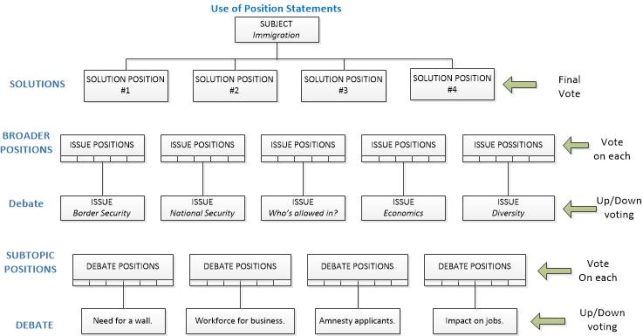
The biggest impact on collaboration and consensus can be the use of “Position Statements”. For example, a small subtopic like “Diversity from Immigration” will result in a range of “Position Statements”. These will be a variety of summarizations and final stances on this subtopic. What’s important is that these “Position Statements” will have been vetted throughout the debate. They will have either solved all of the challenges or are flagged with warnings about problem areas.
Here’s where consensus comes in. We will be able to see the common ground between the “Position Statements”, as well as what minor variations can be easily resolved. “Position Statements” will seek the greatest number of votes and so be encouraged to merge and compromise with other positions.
Even positions that seem far apart can be better understood, increasing the chances of bringing both sides closer together. In the process, fresh out-of-the-box ideas may emerge that could redefine our path to a solution.
The full citizenry will vote on the “Position Statements” that they deem best. So we will be creating an internal poll of the masses to help us as a society to move in a direct democratic path.
As the debate moves up the chain to higher level topics, these too will have their own “position statements”. Eventually we will see and vote upon “position statements” for the main subject like Immigration Policy.
For more on the term consensus…
Supporters of an opinion will collaborate to write their best explanation. The statement will express their rationale and ideas for moving forward. Their goal is to gain support from citizen voters by accommodating the broadest range of perspectives. This is building consensus.
These “Position Statements” will also be challenged. Opponents can challenge accuracy and proof, leaving the position statements with negative warning tags. These challenges must be addressed. For instance, you can no longer praise diversity, and ignore the discomfort humans feel from our differences. You cannot be against diversity and not acknowledge that differences still come from the generation gap, economic disparity, tastes, and our view of life. A position statement might effectively say that they don’t care, but they must state it and suffer the consequences of that attitude.
We might find that there is a strange new dynamic. Much of our polarization on issues stems from either incomplete information, an unbalanced view, or distorted interpretations of facts. Once people see the complexity and intricacy in the issues, and discover the reasoning of their fellow citizens, the more they will tend to soften. It will be humbling, but also mind opening.
The citizenry is going to get smarter.
The writing will have to be in terms we all understand. There will be a continual push for clarity and the use of simpler terminology.
The end result will be an unexpected invigorating challenge for the writers of “position statements”. The writers will be as surprised as the rest of us at seeing perspectives they have never heard before. They will also have the polling data from citizen’s votes. There will be a flurry of robust and hybrid position statements. Each will be using consensus thinking to gather voting support from the most number of citizens.
Citizens will make non-binding votes on these “position statements.” We can use ranked voting or other techniques. For instance, you select your 1st, 2nd, and 3rd choice. We are awaking our national opinion.
An example of how we might debate gun control…
↑ TOP
The Decision Website can have a notification mechanism to inform the general public of activity in our areas of interest. Primarily, it will let us know when subtopics are getting close to the voting stage.
Folks might also create advocacy groups, that help citizens participate more actively on a topic. As the debate unfolds, the advocacy group can notify you of progress, explain some issues, point out areas of concern, and give you links for needed up/down-votes. When the decision process is time sensitive for voting, advocacy groups can help make our participation easier.
That said, advocacy groups have the risk of doing the peoples’ thinking for them. This is not what we want, and yet in a free country we cannot stifle the right to bond together in a common voice. People are also very busy in their own right and may not have the time for significant engagement in the debates. We must count on the fact that we are offering individuals a clear readable and vetted explanation of the issues
When citizens enter the Decision Website, they will see an outline of the debate subtopics and threads. They will be made aware of areas with unresolved disputes. AI will do a lot of this statistical and mapping work for us.
For more on using AI…
The important element will be for you to ensure that your opinions are included in the debate, and that they are being sufficiently addressed.
◆◆◆◆◆◆◆◆◆
Most people will be content to let the debate process unfold. Eventually, we will all want to see the positions that have formed. The really nice thing is that we can look up a topic, see well-written and well-rounded summaries, and become more broadly educated and balanced. We could become a very smart citizenry in a short period of time.
↑ TOP
So now we have debated the subtopics. And we have voted on their respective “position statements” letting our voices be heard. These votes were non-binding and are used like polling data. But they reveal much about how we think as a nation.
Now “position statements” have been written for the full topic (e.g. Immigration Policy). It’s not a detailed set of laws but a statement of what we want to accomplish and how we plan to get there. The writing is clear and concise, written for the general public.
When ready, the Decision Website and our advocacy groups will notify the citizenry for the final vote. The number of options will be far broader than we are used to seeing. The consensus process has encouraged new possibilities. Ranked voting is likely as well as run-offs. The result is a valid national opinion.
◆◆◆◆◆◆◆◆◆
We are initially putting a good amount of work and energy into building national opinions. However, new information will arise, situations will change, sentiment might shift, and evidence of shortcomings may surface. We will revisit and update our debates, but we do not have to lose our initial work.
Consensus is the goal. Consensus is the process of seeking solutions that most everyone can agree to. It usually means compromise or compensation, or at least addressing all of the opposing views. Consensus forces us to acknowledge that our opinions are often not taking everything into account. Consensus recognizes the complexity of life and the diversity of how we want to live.
For an explanation of consensus…
Virtually every position or opinion has merit. Each position recognizes a problem or sees a benefit. The website seeks to prevent us from… being polarized, shuffling aside opposing opinions, letting the majority overpower the minority, and leaving ideas unheard.
More on this problem…
There will be methods built in to stall a position until all issues have been addressed. There will be ways for a minority position to demand attention and ensure that they are heard. If opposing views are strong enough, it will likely force a supermajority vote (like 70%) to overcome the opposition.
◆◆◆◆◆◆◆◆◆
Ultimately, our goal is to blend our diverse viewpoints into solutions that are more effective and innovative than any single opinion we started with. By striving for compromise and creativity, we aim to develop outcomes that surpass our initial perspective.
↑ TOP
Security
Computers – we know they can be hacked. We cannot allow our vote to be used by anyone else. We cannot allow anyone to tamper with our results.
We can use blockchain technology to encrypt and replicate the system across multiple computers, in many locations, and in the hands of virtually anyone. No one can make a change unless effectively all of the computers agree. It forces the rules to be followed.
◆◆◆◆◆◆◆◆◆
So, how does the system know it is you voting? There has to be a connection to the real you. This problem is seen throughout the Internet. The likely solution will involve multi-factor authentication. You typically submit a password, then you might get a security question like “What was your elementary school?” You could get validated by a phone text or email with a secret code, or some other strengthening step.
In the future, after we establish trust in our system, we might use timestamped biometric methods such as fingerprints, eye scan, facial scan, hand geometry, or voice recognition. I know, all of these are weird, but in a world controlled by citizens, technological progress is not so invasive and scary.
◆◆◆◆◆◆◆◆◆
Is AI a dark unknown part of the website that could be a security risk or move our debate without our consent? You bet it is! And we have to solve that issue.
First, note that AI is not being used to participate in the actual debate. It is a tool for accumulating ideas to be considered. AI will help organize and report progress. And most importantly, AI is not a source of authority to be used in our debate.
In fact, the Decision Website becomes the balance for AI, letting humans collectively come to solid conclusions rather than relying on the output from a machine. AI is remarkable compared to a single human, but collectively humans can be the better thinker.
◆◆◆◆◆◆◆◆◆
This is just the tip of the iceberg since many thoughtful people will add more ideas to the security issues. In fact, I can’t help but wonder about the hacker or community of elite tech enthusiasts. Not the ones employed by nation states or involved in scamming money. But those folks with exceptional skills who deserve recognition and seek freedom and equality like the rest of us. What they could bring to this project could be immense. This might be a time where hackers find their true place in history. It’s amazing what the world might look like when “all of us” chart the goals and direction.
◆◆◆◆◆◆◆◆◆
Once again, thank you for taking the time to consider the Decision Website. Thank you for recognizing that you have a role in our democracy.
Suggested Next: Scenario to Move Forward
↑ TOP